
What Is Lava Stone, Exactly?
Lava stone is a type of igneous rock that forms when volcanic lava erupts and cools quickly at the earth’s surface. That rapid cooling is what gives lava stone its fine-grained texture and naturally porous surface — as the rock hardens, trapped gases escape and leave behind tiny air pockets throughout the stone.
Scientifically, lava stone is categorized as a mafic rock — high in magnesium and iron, with a mineral makeup that typically includes pyroxene, olivine, amphibole, and plagioclase feldspar. These minerals are a big part of why lava stone is so hard and dense.
In practical terms, what this means for a building material is: it handles heavy foot traffic well, it doesn’t heat up much under direct sunlight, it naturally grips wet surfaces, and it holds up well outdoors for a very long time.
Where Does Bali Glazed Lava Stone Come From?
Our lava stone is quarried from the slopes of Mount Merapi in Yogyakarta, Central Java — one of the most active volcanoes in Indonesia and the source of some of the finest volcanic andesite in the region.
This same type of stone was used to build Borobudur, the 9th-century Buddhist temple in Central Java that’s now a UNESCO World Heritage Site. Borobudur was constructed from around 55,000 cubic metres of volcanic andesite blocks, all fitted together without any mortar, and it’s been standing for over 1,200 years. That’s not a bad endorsement for the material.
So What Does “Glazed” Mean?
Raw lava stone is tough, but it has one obvious downside: the porous surface soaks up water, stains easily, and tends to grow moss or algae if left exposed — especially in humid climates. For interior or pool use, that’s a problem.
Glazing solves that. The process involves fusing a thin layer of mineral-based glass coating onto the stone surface at high temperature. Once fired, the glaze forms a smooth, sealed finish over the stone that blocks moisture from getting in, makes the surface easy to wipe clean, and resists moss and algae from forming.
What you’re left with is a tile that looks polished and finished like a ceramic, but still has the weight and character of real volcanic stone underneath. Because the stone itself isn’t uniform — it’s natural rock, after all — each tile still looks slightly different from the next. That variation is part of what makes it interesting to work with.
At Bali Glazed Lava Stone, every tile is hand-finished individually by craftspeople in our workshop. The glaze isn’t just a functional coating — the color variants are developed specifically to complement different design directions, from warm earthy tones to deep oceanic blues.
Colors and Sizes Available
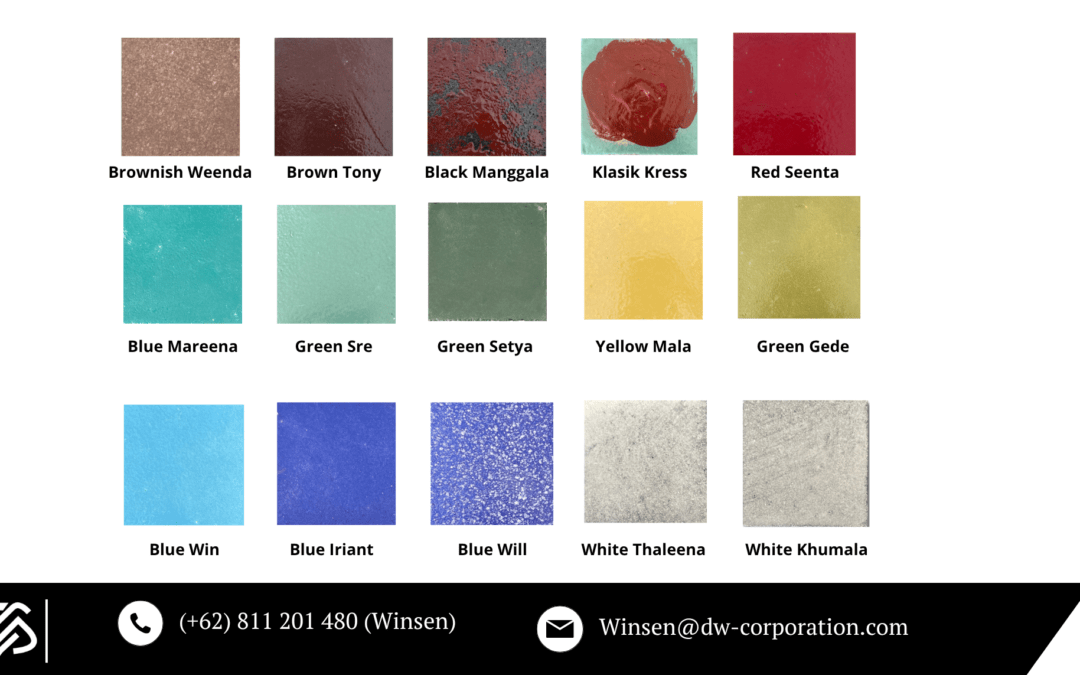
The glazing process is what makes the wide color range possible. We offer 15 color variants: Brown Weenda, Brown Tony, Black Manggala, Klasik Krees, Red Seenta, Blue Mareena, Green Sree, Green Setya, Yellow Mala, Green Gede, Blue Win, Blue Iriant, Blue Will, White Thaleena, and White Khumala.
Tiles come in 10 mm and 20 mm thickness. Standard sizes run from 100 × 100 mm on the smaller end up to 600 × 1,200 mm for larger format applications, with 50 × 200 mm, 100 × 200 mm, 300 × 600 mm, and 400 × 600 mm in between. Custom sizing is available for larger projects.
Where Is It Used?
Swimming Pools
Pool use is one of the most popular applications. The glazed surface holds up against chlorine and resists algae, while the underlying stone stays naturally cool underfoot even on hot days. The blue variants — Blue Will and Blue Win in particular — are often used to get that clean, tropical pool look.

Countertops and Table Surfaces
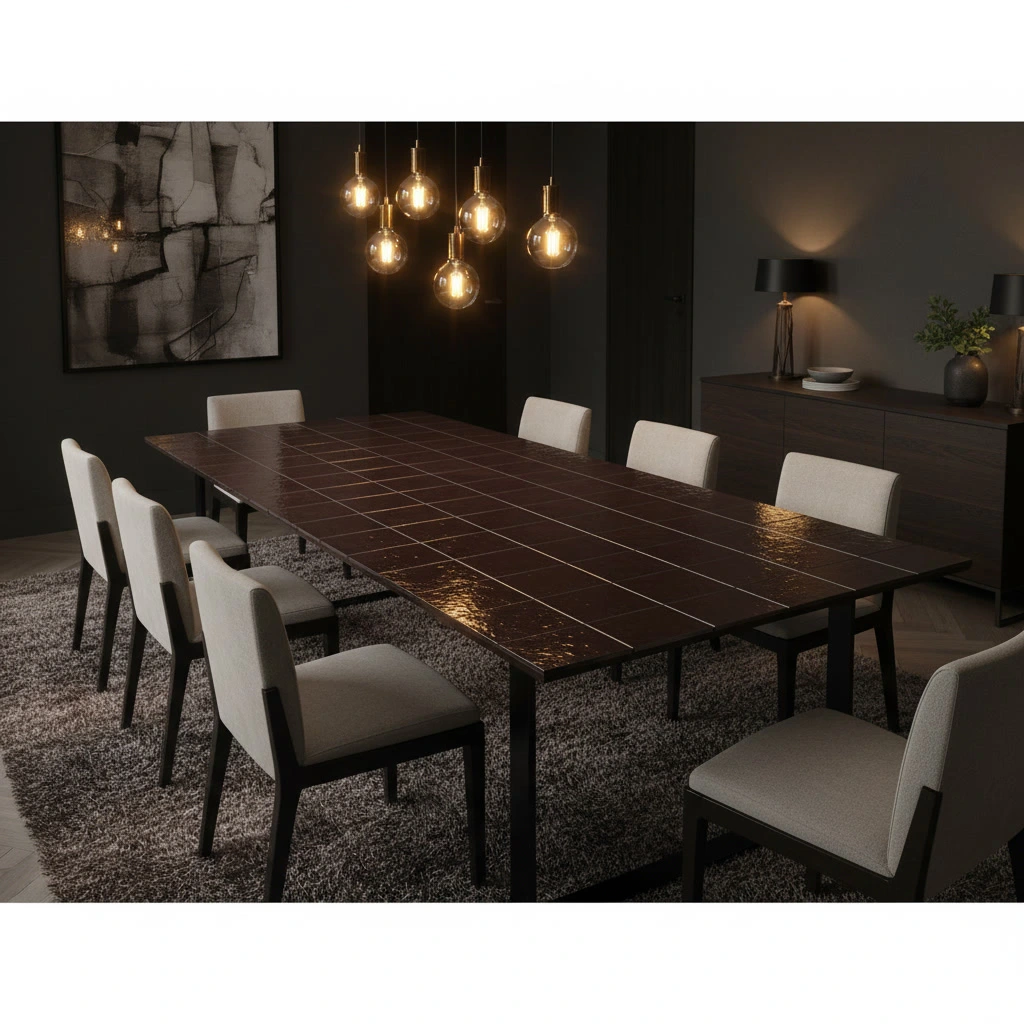
The sealed surface is practical for horizontal surfaces like dining tables, bar counters, and kitchen backsplashes. It’s easy to clean and holds up well to everyday use.
Common Questions
Is it slippery when wet?
The stone itself has natural grip. For areas that get consistently wet — pool edges, outdoor showers — we’d recommend going with a matte or semi-gloss glaze rather than a high-gloss finish, and opting for the 20 mm thickness for added surface texture.
Does it work in cold climates?
Yes. Volcanic andesite is dense enough to handle freeze-thaw conditions without cracking, so it’s not limited to tropical use.
Can it be used on tabletops?
It’s one of the better natural stone options for tables, actually. The glaze keeps liquids from soaking in, so it’s far more practical than unfinished stone for surfaces that get daily use.
How does international shipping work?
We ship to 90+ countries. Products are packed with Styrofoam padding inside solid wood crates, strapped and sealed for long-distance freight.
If you’d like to see the full product range or get a quote for your project, for consultation and more information about Green Bali Stone products, feel free to contact our team:
📞 (+62) 811 201 480 (Winsen)
📧 Winsen@dw-corporation.com
🌐 baliglazedlavastone.com
Our team will be happy to help you choose the best natural stone solution for your project.